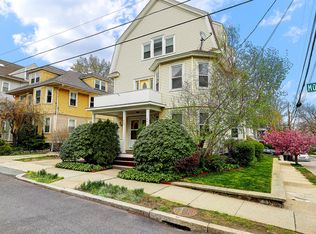
The Blackstone neighborhood is located in the northeast corner of Providence's East Side. Most of its development occurred during the early and mid 20th century. The houses, mostly medium to large single-family dwellings, were architecturally and functionally different from those built in College Hill during the 18th and 19th centuries. Blackstone is one of only a few neighborhoods in the city where considerable development occurred during the 20th century.During the middle years of the 19th century, Blackstone began to develop as a middle and upper income residential neighborhood, though the area's isolation from the rest of the city precluded substantial growth. Before the 1880s, residents traveled between the Blackstone area and the rest of Providence, either by carriage or public horse car along a circuitous route from Downtown through Fox Point to Butler Avenue. In 1884, a second line along Waterman and Angell Streets was completed, which allowed a more direct route downtown.The most significant improvement that stimulated residential development in Blackstone was the collaboration between the proprietors of Swan Point Cemetery and the City of Providence to construct a landscaped boulevard, 200 feet wide, connecting the Waterman and Angell Street corridor on the south with Hope Street on the north at the Pawtucket city line. By 1894, Blackstone Boulevard was completed and landscaped. Today, it remains one of the city's greatest examples of planning and landscape architecture.Between 1890 and 1923, land values along the boulevard tripled and the Blackstone area began to fill in with single-family homes that were architecturally distinctive. During this period, Blackstone became one of the most desirable and fashionable addresses in the City.The scenic beauty created by the bluffs overlooking the Seekonk River was inviting and conducive to institutional establishment. Butler Hospital, one of the nation's oldest psychiatric institutions, was built in 1847 on the Richard Browne Farm at the end of Rochambeau Avenue. Its gothic structure was landscaped in a rural setting as part of a plan to remove patients from the stresses of the everyday world.Swan Point Cemetery was established adjacent to the hospital grounds in 1847 as part of the nation's rural cemetery movement of the 1830s and 1840s. The grave of H.P. Lovecraft, the horror and science fiction writer, is located there with an epitaph reading "I Am Providence." Together, the cemetery, the hospital, and Blackstone Boulevard provide substantial open space in the northeastern corner of the City.By the 20th century, institutional growth became more neighborhood oriented. Some of the notable religious institutions include the Central Baptist Church on Lloyd Avenue, Temple Emanuel on Taft Avenue, and St. Sebastian's Roman Catholic Church on Cole Avenue. Today, the Blackstone neighborhood remains primarily residential and is one of the City's more affluent neighborhoods.With nearly two out of three housing units occupied by their owners, Blackstone has the highest rate of home ownership of any neighborhood in the City. More than half of all housing units in Blackstone are single-family, detached homes, and almost 9 out of 10 housing units were constructed more than 40 years ago.
This property is off market, which means it's not currently listed for sale or rent on Zillow. This may be different from what's available on other websites or public sources.