Key Takeaways from the December New Home Sales Report
Written by Frank Molina on January 27, 2015
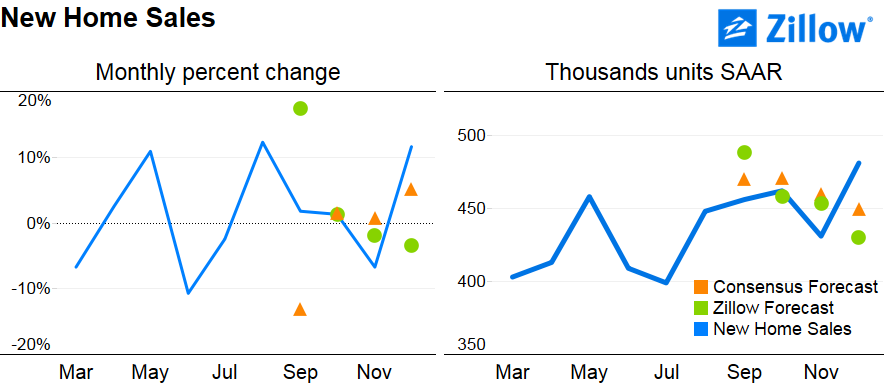
- New home sales rose 11.6 percent in December from November, and 8.8 percent year-over-year, to 481,000 units (SAAR).
- The median sales price of new homes fell 0.3 percent month-over-month, but rose 8.3 percent year-over-year to $295,500 (SA).
- Zillow expected a monthly decrease of 1.8 percent to 430,000 units (SAAR), while the consensus forecast was an increase of 3.1 percent.
New home sales are roughly twice as volatile as existing home sales[i], a point proven in December after new home sales rose 11.6 percent from November, to 481,000 units at a seasonally-adjusted annual rate (SAAR), reversing a 1.6 percent monthly decline in November, according to the U.S. Census Bureau. This jump is almost five times larger than December’s 2.4 percent monthly increase for existing home sales. The magnitude of this month’s change is slightly outside the norm: Only about 4 percent of monthly percent changes in new home sales have been larger since 1999.
Sales of new homes finished the year up 8.8 percent from the December 2013 level of 442,000 units (SAAR). The median sales price of existing homes fell 0.3 percent month-over-month in December, but rose 8.3 percent over the year to $295,500 (SA).
According to the U.S. Census bureau, the average length of time to complete a for-sale home from start to completion was five months in 2013. Construction starts for single-family homes were up 3.9 percent on an annual basis in August (the month when new homes sold in December were most likely to have been started) and were up 9.4 percent and 14.8 percent year-over in July and September, respectively. Taken together, the strong number of new home starts in late summer and early fall contributed to December’s strong sales number.
Zillow predicted new home sales would continue their recent trend and fall 1.8 percent from November, to 430,000 units (SAAR). The consensus forecast was an increase of 3.1 percent. The combination of falling interest rates and modest improvements in mortgage credit availability helped offset the effects of a rising homeowner vacancy rate and falling homeownership rate during the third quarter.
[i] Volatility is measured by the variance of monthly percent changes.
Sign up for Zillow Research updates
Subscribe to receive weekly emails for the latest Zillow research, weekly housing data, market insights and more.
Related Articles



Research in your inbox
Get the latest housing data and analysis from Zillow's economists — delivered when the numbers update.

