Sept. Existing Home Sales Expected to Rise 2.1 Percent
Written by Aaron Terrazas on October 17, 2014
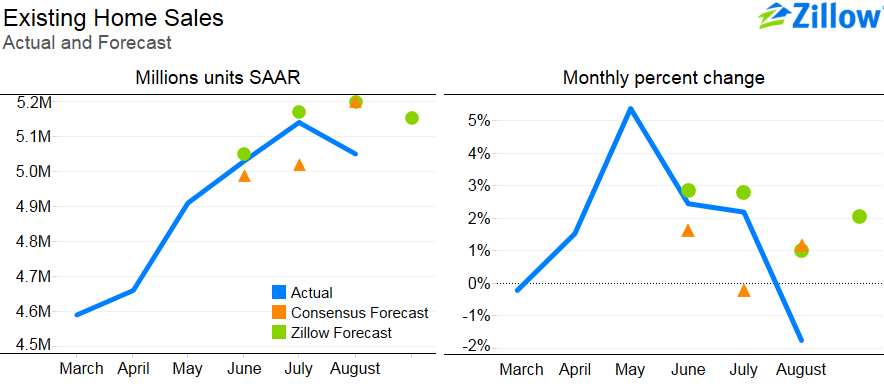
- We expect existing home sales to increase to about 5.15 million units (SAAR) in September, up 2.1 percent from August.
- The expected increase in existing home sales is driven by the combination of strong pending home sales in July and weak existing home sales in August.
Zillow expects Tuesday’s existing home sales data from the National Association of Realtors to show a rise of as much as 2.1 percent in the number of sales in September, to a seasonally adjusted annual rate (SAAR) of 5.15 million units, up from 5.05 million units in August.
But there are a number of variables that could lead to results considerably less than what our models predict. These risks include:
- Less recent and somewhat volatile homeowner vacancy data
- A homeownership rate that has been falling but is difficult to predict
- Median income that is growing, but maybe not fast enough
(Read more about the risks to our forecast here.)
Background
Existing home sales in August were down 1.8 percent from July and 5.3 percent year-over-year. Sales had been slowly but steadily increasing since late 2010, before dropping sharply last summer. They recovered somewhat in spring and summer 2014, regaining about two-thirds of the decline recorded between July 2013 and March 2014, before falling unexpectedly in August.
Forecast
Our existing home sales forecast uses two models, a structural model and a historical model. These two models typically move together. But in our latest forecast, the models moved in opposite directions, yielding very different predictions. The historical model suggests existing home sales will total 5.15 million units (SAAR) in September, up 2.1 percent from August, while the structural model suggests existing home sales will total 4.97 million units (SAAR), down 1.6 percent from August.
Assumptions about the homeowner vacancy rate and the homeownership rate – which we forecast forward from June 2014 – help inform both models. In order for the results of the structural model to approach the results of the historical model, the homeownership rate or the homeowner vacancy rate would have had to improve dramatically over the summer. It is unlikely that both variables moved that much since June.
Because the structural model is very sensitive to these underlying assumptions, we are inclined to place greater weight on the results of the historical model.
Sign up for Zillow Research updates
Subscribe to receive weekly emails for the latest Zillow research, weekly housing data, market insights and more.
Related Articles



Research in your inbox
Get the latest housing data and analysis from Zillow's economists — delivered when the numbers update.

