Key Takeaways from the June Existing Home Sales Report
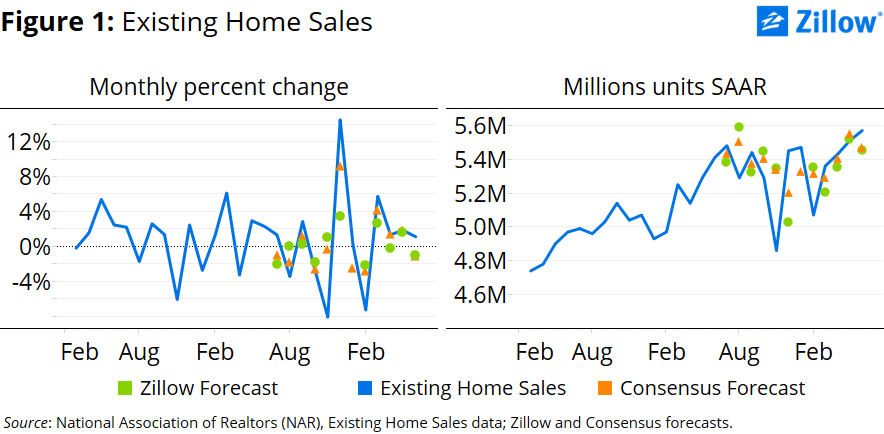
June existing home sales moved decisively upward, defying expectations for a small decline, rising 1.1 percent to 5.57 million units at a seasonally-adjusted annual rate (SAAR) according to the National Association of Realtors (NAR).
June existing home sales increased 1.1 percent from May to 5.57 million units at a seasonally-adjusted annual rate (SAAR), defying expectations for a small decline.
June marks the fourth consecutive month in which home sales have declined year-over-year in the West but increased in all other regions.
Tight inventory, particularly among single-family homes, continues to weigh on the market.
June existing home sales moved decisively upward, defying expectations for a small decline, rising 1.1 percent to 5.57 million units at a seasonally-adjusted annual rate (SAAR) according to the National Association of Realtors (NAR). It was the fourth consecutive monthly increase in home sales, the longest string of rising home sales in two years.
June existing home sales were up 3 percent year-over-year, slightly lower than the annual pace of growth recorded in April and May (figure 1). Single-family home sales posted stronger year-over-year gains than the condo/coop category in every month during the first half of 2016. In June, single-family home sales were up 3.1 percent from last year, while condo/coop sales were up 1.6 percent over the year.
n
n
June Existing Home Sales: The West, and the Rest
Regionally, there is an increasingly sharp divergence between home sales trends in the West and the rest of the nation. For four consecutive months, home sales have increased year-over-year in the Northeast, Midwest and South regions, but have declined year-over-year in the West. Since March, existing home sales have been growing at a median annual pace of 3.9 percent in the Midwest, 11.2 percent in the Northeast, and 3.5 percent in the South – but have declined at a median annual pace of 2.1 percent in the West.
Despite growing sales, tight inventory continues to weigh on the market. The number of homes for sale in June fell 1.3 percent from May to 2.0 million units (SAAR) – the third consecutive month of contracting inventory. Over the year, the number of U.S. existing homes for sale is down 5.95 percent, the 13th consecutive month of year-over-year declines in for-sale inventory. The decline in for-sale inventory has been much sharper among single-family homes than among condo/coops. For-sale inventory of single-family homes was down 6 percent year-over-year compared to a 3.2 percent drop for condos/coops over the same time.
The median, seasonally-adjusted price of existing homes sold nationwide was essentially flat in June, up 0.1 percent over the month to $229,300. Over the year, the median price of existing homes sold is up 4.9 percent – slightly faster than the 4.3 percent annual pace recorded in May, but slower than it has been at any other point in almost a year (since August 2015).
Again, there are important regional divergences: the median seasonally-adjusted price of existing homes sold in the West was up more (7.2 percent year-over-year) than elsewhere. The median seasonally-adjusted price was up 5.7 percent in the Midwest, 5.5 percent in the South and 1.4 percent in the Northeast.