Young Adults are Stacking Up, But Not Shacking Up
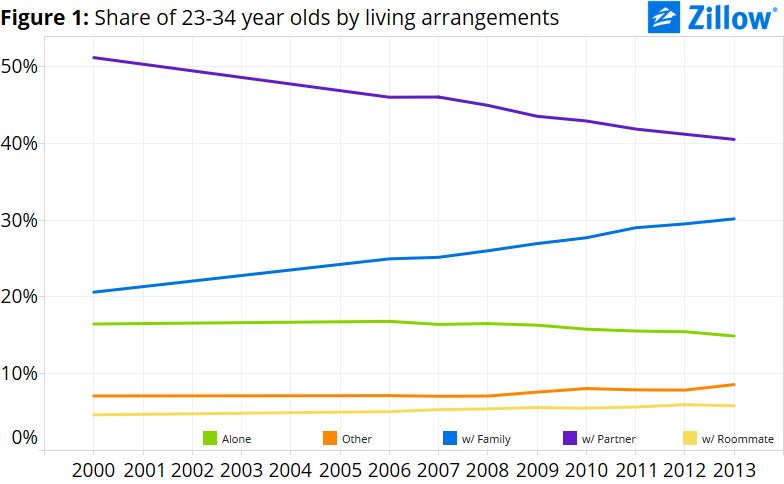
- The percentage of 23- to 34-year-olds living with family increased 46 percent between 2000 and 2013.
- The share of 23- to 34-year-olds living with a partner fell 21 percent between 2000 and 2013.
As if it wasn’t obvious before, it’s clear now: Living with your parents, while financially prudent, sure isn’t sexy.
More young adults are doubling-up in order to cope with stagnant wages and rising housing costs. But fewer of them are shacking up with partners, and more are simply moving back home.
Income among 23- to 34-year-olds is still not at pre-recession levels. At the same time, rent is getting increasingly unaffordable. As a result, in order to help shoulder the load and split costs, more young adults are packing into fewer households, increasing household size but contributing to a sluggish rate of new household formation.
And the trend is similar among older adults, too.
To gain a better understanding of the changing distribution of living arrangements, Zillow examined American Community Survey (ACS)[1] data to study five different types of common living arrangements:
- Living alone
- Living with family (other than a spouse/partner)
- Living with roommates[2]
- Living with a partner (a boyfriend, girlfriend, fiancé or spouse)
- “Other,” which is essentially any living arrangement which doesn’t fit into the above categories
The popular narrative that millennials are moving in with mom and dad seems to be borne out by the data. But while the share of young adults moving into their parents’ basement has risen, the share shacking up with a partner has fallen (figure 1).
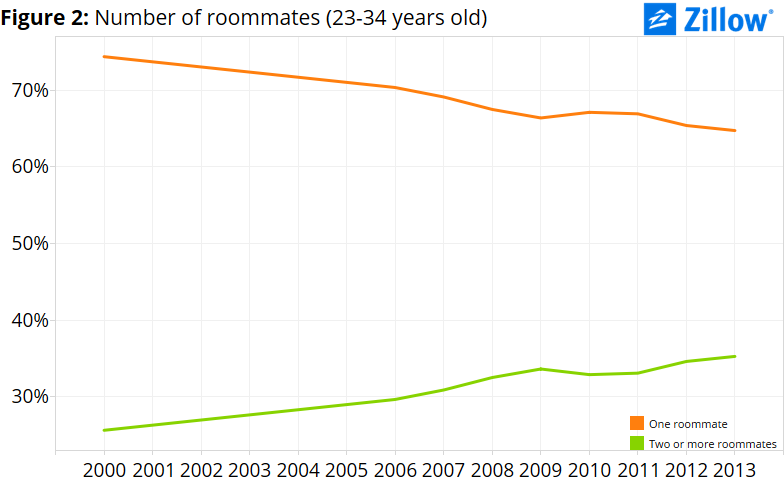
And while three may be company, that’s not stopping 23- to 34-year-olds from living with two or more roommates at a higher rate (figure 2).
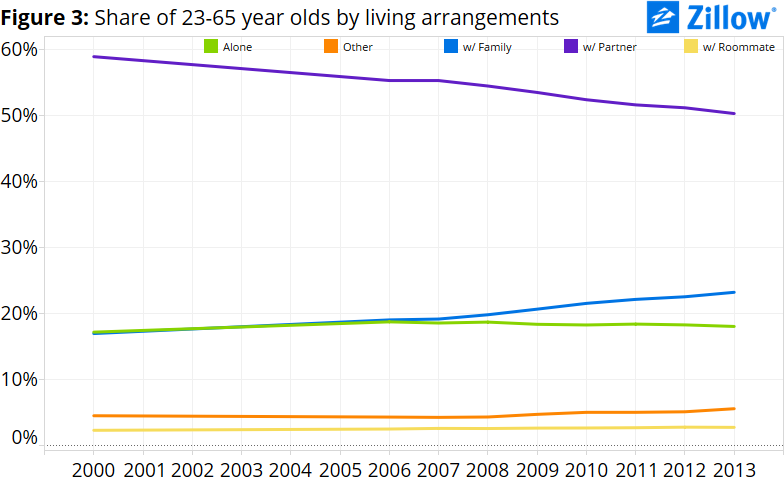
The story is similar among all working-age adults (aged 23 to 65); a smaller share of working adults are living with their partners, and more are living with family (figure 3).
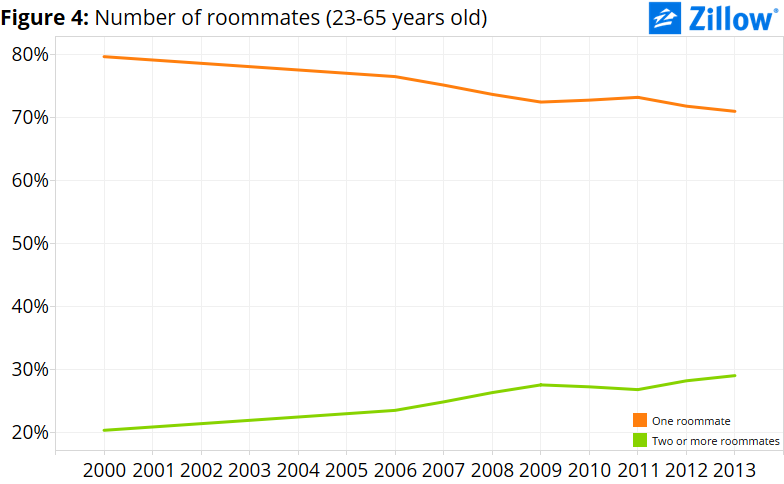
There is also a decrease in the share of adults in general that are living with only one roommate, and an increase in the share living with two or more roommates (figure 4).
[1] Steven Ruggles, J. Trent Alexander, Katie Genadek, Ronald Goeken, Matthew B. Schroeder, and Matthew Sobek. Integrated Public Use Microdata Series: Version 5.0 [Machine-readable database]. Minneapolis: University of Minnesota, 2010.
[2] Roommate here is defined to be non-related and non-partnered individuals living together.
Sign up for Zillow Research updates
Subscribe to receive weekly emails for the latest Zillow research, weekly housing data, market insights and more.
Related Articles



Research in your inbox
Get the latest housing data and analysis from Zillow's economists — delivered when the numbers update.

