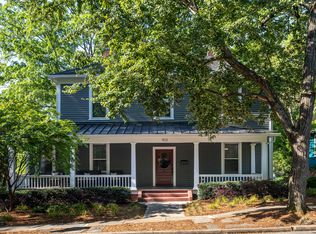
Listed on the National Register of Historic Places in 1985. Before its development beginning in 1907, the property which is now Boylan Heights was once a large wooded site. From its apex at Montfort Hall, the land slopes steadily downward toward the east, south, and west. Instead of the right angle grid of streets common to Raleigh's earlier development, Boylan Heights was platted with the city's first curvilinear grid, designed to respond to the sloping topography of the site. Large, mature deciduous and evergreen trees fill many lots. Shade trees line the street rights-of-way, which have also been planted with dogwoods or crepe myrtles. Wooden electrical and telephone poles carry wires throughout the neighborhood along streets and down alleys, supporting standard "cobrahead" street lighting fixtures. Front yards are generally lawns from street sidewalk to house, usually open without an enclosing fence. Boylan Avenue's prominence is reinforced by a deeper than average front yard setback. Front porches found on virtually every residence throughout the district link house to street. Foundation plantings are common. Boylan Heights is an eclectic family neighborhood within walking distance of downtown, NC State, Farmers Market, the rolling hills of nearby Dix Hill, and the Pullen Park carousel, train and indoor public pool. Each Halloween Boylan Heights pumpkins pose for their picture by Michael Zirkle on the Boylan Avenue bridge overlooking the expanding city skyline that includes the new RBC tower and the "shimmer wall" of the new civic and convention center.
This property is off market, which means it's not currently listed for sale or rent on Zillow. This may be different from what's available on other websites or public sources.