Sellers Cut Prices at Record Levels as Housing Market Moves in Buyers’ Favor
The biggest discounts are in markets where inventory has surged and homes take longer to sell.


Written by Susan Kelleher on December 29, 2025
Edited by Jessica Rapp
Key takeaways
- Price cuts signal changing seller expectations. When sellers cut their prices, it’s a sign that they’re more willing to make a deal, especially during the slow winter season. Buyers shopping in markets where there’s a large share of discounted homes can use the cuts as a sign of a market’s competitiveness.
- The typical cut remains $10,000, but more sellers are opting for multiple cuts. Pricing strategies reflect market conditions. Cuts are more common in markets that favor buyers. Sellers should stay connected to their agents, and adjust prices as market conditions change.
After several years of record-setting price increases, the housing market set a different kind of record: the steepest price discounts we’ve seen in at least eight years, according to a Zillow analysis of October 2025 data.
The record price cuts amounted to $25,000 on a typical U.S. listing, and provided one more sign that the housing market continues to move in buyers’ favor. The typical discount measured in October is cumulative, meaning that sellers have been making multiple cuts to attract buyers, especially in markets where inventory has surged and homes are taking longer to sell.
In the month following these exceptionally high discounts, the share of price cuts nationally had dropped down from more than 1 in 4 to about 1 in 5 homes — a more typical level for the season. The likely reason, according to Zillow economists: sellers who didn’t find buyers opted to unlist their homes and wait until the busy spring selling season, when buyers tend to turn out in droves.
Still, the winter season presents opportunities for deal-making as there’s likely to be less competition among buyers and a greater number of homes that have been on the market for a while.
What the price cuts tell us
The cuts are a sign that sellers are willing to part with some of the gains they’ve enjoyed since home values took off during the pandemic.
“Most homeowners have seen their home values soar over the past several years, which gives them the flexibility for a price cut or two while still walking away with a profit,” said Zillow Senior Economist Kara Ng. “These discounts are bringing more listings in line with buyers’ budgets.”
The combination of price cuts, lower mortgage interest rates and flat or declining home values in many markets helped make homes the most affordable they’ve been in three years.
For buyers and sellers currently in the market, the discounts may underscore the need to adjust buying and selling strategies as the market rebalances in favor of buyers. With that, here’s where we’re seeing the biggest discounts.
Metros with the biggest price cuts
As with all things real estate, the story varies among local markets. The typical price cut on listings continues to hover near $10,000, but multiple reductions are becoming more common as homes take longer to sell, according to the analysis.
In terms of dollars, the nation’s pricey coastal markets saw the biggest price cuts, led by San Jose ($70,900), Los Angeles ($61,000), San Francisco ($59,001), San Diego ($50,000) and the New York metro area ($50,000).
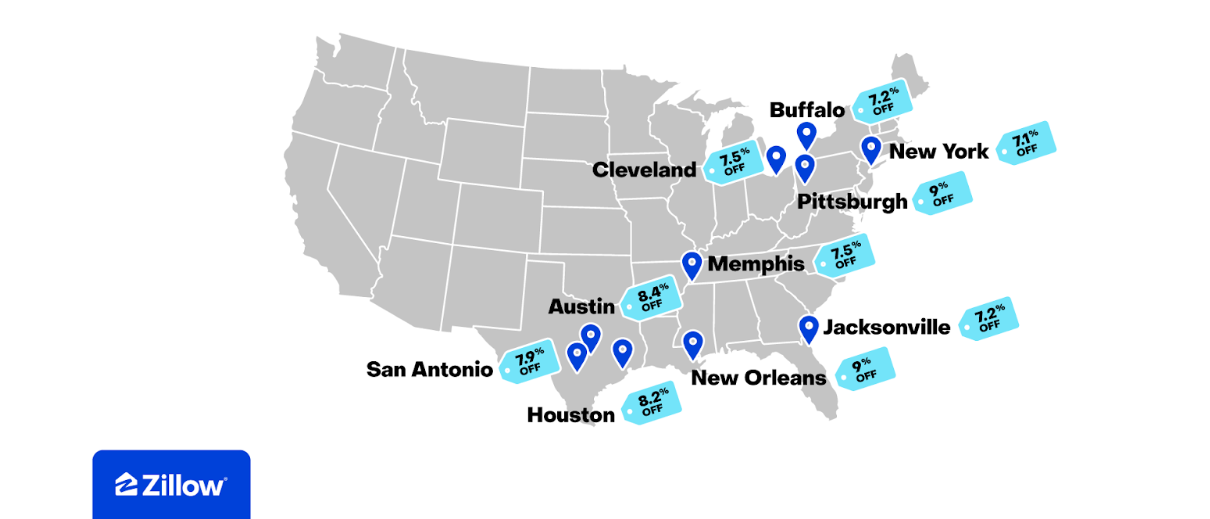
In percentage terms, the discounts represent a larger share of the price in more affordable markets like Pittsburgh and New Orleans, where a typical markdown of $20,000 represents about 9% of the typical home value.
Sellers in metros where homes are selling more quickly haven’t cut prices as much. For instance, in Oklahoma City and Louisville, the typical price cut in October was $15,000.
10 markets with the biggest discounts relative to home values
15 markets with the largest total price cuts
Sellers continue to cut prices to attract buyers. This chart shows metros where sellers have cut the most on a cumulative basis. (Median represents the mid-point, with half of cuts amounting to more and half amounting to less.)
| Metro | Median Cumulative Price Cut as of October 31, 2025 |
| San Jose, CA | $70,900 |
| Los Angeles, CA | $61,000 |
| San Francisco, CA | $59,001 |
| New York, NY | $50,000 |
| San Diego, CA | $50,000 |
| Boston, MA | $49,900 |
| Seattle, WA | $41,000 |
| Austin, TX | $36,000 |
| Portland, OR | $31,901 |
| Sacramento, CA | $30,900 |
| Providence, RI | $30,400 |
| Miami, FL | $30,100 |
| Riverside, CA | $30,000 |
| Denver, CO | $30,000 |
| Nashville, TN | $28,500 |
15 markets with the largest price cuts in October alone
October marks the start of the slow season in real estate. This year, it also coincided with conditions that continue to favor buyers in most of the nation’s largest metros. (Median represents the mid-point, with half of cuts amounting to more and half amounting to less.)
| Metro | Median price cut in October alone |
| San Jose, CA | $49,000 |
| San Francisco, CA | $36,000 |
| Los Angeles, CA | $30,000 |
| New York, NY | $26,000 |
| San Diego, CA | $25,000 |
| Boston, MA | $25,000 |
| Seattle, WA | $23,002 |
| Providence, RI | $20,000 |
| Hartford, CT | $15,800 |
| Sacramento, CA | $15,050 |
| Austin, TX | $15,000 |
| Portland, OR | $15,000 |
| Riverside, CA | $15,000 |
| Washington, DC | $15,000 |
| Denver, CO | $14,098 |
15 markets where price cuts represent the biggest share of home values
While price cuts may be smaller in these markets, they represent larger savings in terms of a percentage of home values.
| Metro Area | Median price cuts as a share of typical home value in that metro |
| New Orleans, LA | 9.1% |
| Pittsburgh, PA | 9.0% |
| Austin, TX | 8.5% |
| Houston, TX | 8.2% |
| San Antonio, TX | 7.9% |
| Cleveland, OH | 7.5% |
| Memphis, TN | 7.5% |
| Buffalo, NY | 7.3% |
| Jacksonville, FL | 7.2% |
| New York, NY | 7.2% |
| Boston, MA | 7.1% |
| Tampa, FL | 7.0% |
| United States | 7.0% |
| Birmingham, AL | 7.0% |
| Dallas, TX | 6.9% |
Takeaways
For buyers: Price cuts are a sign that sellers are recalibrating their expectations, and are more willing to make a deal to sell their homes. Work with an agent who is an expert in your local market to craft a strategy that reflects local conditions. And stay on top of how much you can afford with BuyAbilitySM, a Zillow tool that estimates how much you can afford to spend on a home given your personal financial situation and current mortgage interest rates.
Find homes in your budget with BuyAbility℠
 Loading
For sellers: Stay informed, especially if you’re in a market where other sellers continue to adjust prices to attract buyers. An experienced agent who is an expert in your market can help you craft a pricing strategy that reflects the dynamics of your market.
Disclaimer: This article includes forward-looking statements based on current expectations and assumptions about housing market conditions, which are subject to change, and actual outcomes may differ materially due to economic, market, and other factors.
A local agent can help you stay competitive on a budget.
They’ll help you get an edge without stretching your finances.
Talk with a local agentRelated Articles



A local agent can help you stay competitive on a budget.
They’ll help you get an edge without stretching your finances.
Talk with a local agent