- Press Releases
Sustainability
Social Impact
Explore how Zillow is driving real progress toward a more affordable and accessible housing market.
- Investors
- Careers
6 min read
Zillow shows how it is building an AI-native housing platform
Zillow is using AI to help consumers go beyond home search into real steps — from affordability to touring to closing

Written by Zillow on April 7, 2026
At its recent AI Summit, Zillow unveiled a more connected, AI-driven real estate experience, one that’s been built on nearly two decades of proprietary data and insights into the housing market.
“AI is changing everything. It’s changing how we find information. It’s changing how we search, how we shop. And of course, it’s changing real estate,” said Zillow Chief Executive Officer Jeremy Wacksman. “And just like the last ‘change-everything moment’ with the mobile revolution, Zillow is leaning in and leading where AI is going in real estate.”
In product demos and leadership sessions, Zillow showed how it is building an AI-native platform that connects search, decision-making and transactions to revolutionize the housing experience.
Zillow’s advantage in AI: content, context and integration
For years, the industry has focused on who owns the first click. Zillow is often where that journey begins, and the company is focused on what happens next.
“Consumers have had thousands of options to choose from for finding a listing or answering that first question,” Wacksman said. “They choose Zillow because we build the great product experiences that they want and need and tell their friends about.”
Zillow leaders often describe this by using the iceberg analogy. What most people see — listings, search results and home details — is just the top. Beneath the surface is a much deeper layer of data and infrastructure: how consumers search and compare over time, what they can afford, tours they schedule, conversations they have and the transactions that follow.
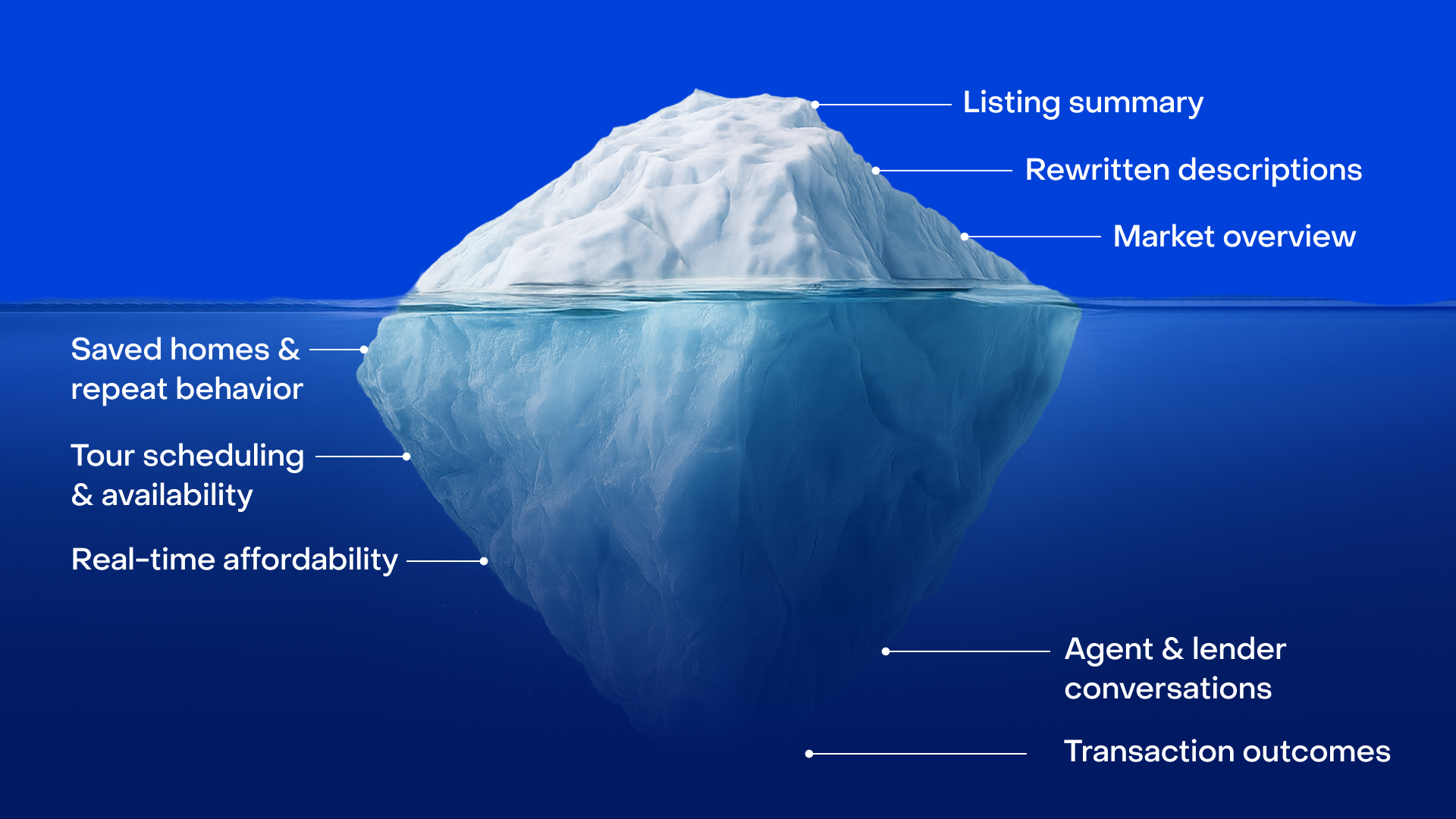
That foundation is solidified by content, context and integration.
Content starts with housing data. Zillow brings together one of the most comprehensive views of available homes — a growing portion of which are unique to Zillow — enriched with pricing signals, property details and immersive media, all of which help consumers understand what they’re seeing.
Context comes from how people actually search. People come to Zillow over weeks or months as they browse, compare and save homes; use financing tools and determine their BuyAbilitySM using Zillow Home Loans; take virtual and in-person tours; and collaborate with their co-shopper and their agent via in-app messaging. That activity creates a clearer picture of what they want and when they’re ready to act.
“That is not casual traffic. That is sustained, deep intent,” Wacksman said. “We don't just answer questions; we personalize the transaction.”
Integration connects the steps that move a transaction forward. Zillow links touring, financing and closing for both consumers and the professionals serving them.
Together, these elements allow Zillow to move beyond returning results and toward helping people understand their options and gain the confidence to take the next step.
A fragmented transaction is becoming a connected experience
AI is more powerful when it sits on top of a deep infrastructure like Zillow’s, rather than simply powering standalone tools.
“Those apps are building at the edge of the transaction while Zillow is building at the core,” said Cynthia Taylor, Zillow senior vice president of product.
Residential real estate is a complex, highly regulated industry. Zillow has developed its products and infrastructure with this in mind, enabling it to support consumers and real estate professionals through each step of a transaction. This allows Zillow to solve one of the industry’s biggest challenges: unifying what has long been a disjointed experience for consumers.
Instead of restarting at every step, Zillow is building a single, continuous profile that captures a person’s intent, financial position, preferences and progress across the entire journey.
“Most people don’t get stuck on inspiration when they’re thinking about renting or buying,” Taylor said. “Most people get stuck on that action — knowing what that next step is and when they’re ready to take it.”
This continuity expands what AI can do. Instead of reacting to isolated questions, it can understand where someone is in the process and help guide what comes next.
That same shift is happening for real estate professionals. Instead of stitching together multiple tools, agents can work from a shared view of the customer and the transaction, with AI suggesting what matters most and what to do next.
“What AI changes is the distribution of work,” Wacksman said. “The administrative burden goes down, and what remains is negotiation, strategy, trust and relationships.”
AI-powered tools can help agents prioritize leads, automate follow-ups and manage more transactions while maintaining a high level of service.
Zillow AI mode is helping consumers move from browsing to action
Zillow AI mode is designed to guide movers through real housing decisions.
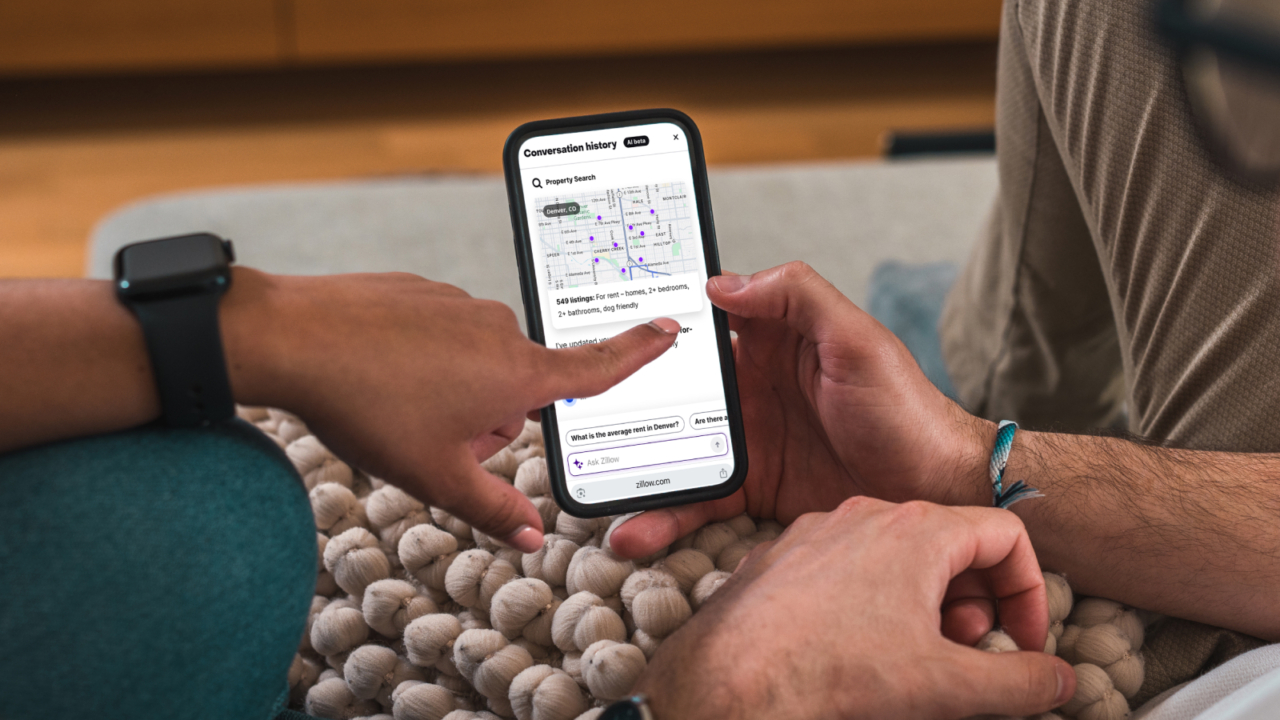
A renter can ask, “Can I afford this apartment if I move in June?” A buyer can say, “Find similar homes within my budget that are closer to light rail.” Unlike when using standalone AI tools, these questions connect directly to Zillow’s live listings data, affordability tools and tour scheduling.
“AI with content answers the question,” said Nicholas Stevens, Zillow vice president of product. “But AI with content, with context … and with integration, that’s what closes the loop.”
AI mode takes a shopper’s evolving preferences into account across sessions, presents relevant homes and helps them evaluate trade-offs between options. Consumers can check affordability, schedule tours and connect with an agent in the same flow.
Zillow is also showing up earlier in the process. With products like Zillow PreviewSM, listings can be shared publicly before they go active, giving buyers greater visibility, and allowing agents and sellers to generate interest ahead of time.
Zillow is built to cross the AI chasm
Rich Barton, Zillow co-founder and co-executive chairman, closed the summit by reiterating that AI is the next major platform shift — a “chasm” that will separate companies that can adapt from those that cannot.
Barton, who is also a venture capitalist and investor, shared his guidelines for evaluating companies’ prospects in the AI era:
- Has founders who are engaged in the company and are caretakers of its mission.
- Is involved in big, complicated transactions that matter.
- Offers unique content and data.
- Contributes hidden depths of integration to an industry’s professional workflows.
- Has command of the consumer funnel, brand strength, low churn and direct traffic.
Zillow checks each of those boxes.
The company has navigated major technology shifts before, including the shift from the internet to mobile. With the team, assets and foundation it has built, Zillow is positioned to do it again and lead the way as AI reshapes real estate.
“I’m more fired up about the opportunity in front of Zillow now — and our position relative to that opportunity — than at any point in our 20-year history,” Barton said.
Related Articles




Sign up for Zillow news updates
Subscribe to receive daily emails for the latest Zillow news and announcements, product updates and more.
%20--%3e%3cdefs%3e%3cstyle%3e%20.st0%20{%20fill:%20%23111116;%20}%20%3c/style%3e%3c/defs%3e%3cpath%20class='st0'%20d='M.67,84.17v-9.38L39.19,20.75v-1.12H1.34V4.67h62.64v9.38l-37.85,54.04v1.12h38.97v14.96H.67Z'/%3e%3cpath%20class='st0'%20d='M75.04,9.36c0-5.58,4.13-9.71,9.94-9.71s9.94,4.13,9.94,9.71-4.13,9.71-9.94,9.71-9.94-4.02-9.94-9.71ZM76.71,84.17V27h16.53v57.17h-16.53Z'/%3e%3cpath%20class='st0'%20d='M106.3,84.17V1.32h16.53v82.85h-16.53Z'/%3e%3cpath%20class='st0'%20d='M135.33,84.17V1.32h16.53v82.85h-16.53Z'/%3e%3cpath%20class='st0'%20d='M161.79,55.58c0-18.42,12.62-30.37,31.71-30.37s31.71,11.95,31.71,30.37-12.73,30.37-31.71,30.37-31.71-11.95-31.71-30.37ZM208.58,55.58c0-9.49-6.25-16.19-15.07-16.19s-15.18,6.7-15.18,16.19,6.25,16.3,15.18,16.3,15.07-6.81,15.07-16.3Z'/%3e%3cpath%20class='st0'%20d='M246.32,84.17l-17.2-57.17h16.86l11.61,40.64h1.12l10.16-40.64h16.53l10.94,40.98h1.12l11.39-40.98h16.41l-17.31,57.17h-21.55l-8.71-37.85h-1.12l-8.6,37.85h-21.66Z'/%3e%3cpath%20class='st0'%20d='M362.44,84.17V4.67h56.94v15.86h-38.3v17.53h33.5v14.51h-33.5v31.6h-18.65Z'/%3e%3cpath%20class='st0'%20d='M428.76,84.17V27h16.3v7.82h1.23c2.46-5.36,8.04-8.93,14.07-8.93,2.34,0,4.69.56,6.48,1.45v14.85c-3.24-1.45-7.03-2.12-9.38-2.12-7.26,0-12.17,6.03-12.17,14.85v29.25h-16.53Z'/%3e%3cpath%20class='st0'%20d='M471.64,55.58c0-18.42,12.62-30.37,31.71-30.37s31.71,11.95,31.71,30.37-12.73,30.37-31.71,30.37-31.71-11.95-31.71-30.37ZM518.43,55.58c0-9.49-6.25-16.19-15.07-16.19s-15.18,6.7-15.18,16.19,6.25,16.3,15.18,16.3,15.07-6.81,15.07-16.3Z'/%3e%3cpath%20class='st0'%20d='M545.11,84.17V27h16.52v8.04h1.12c4.24-6.48,9.71-9.71,16.64-9.71,12.95,0,21.55,10.05,21.55,23.78v35.06h-16.52v-32.72c0-7.03-4.02-11.95-10.72-11.95s-12.06,5.25-12.06,12.51v32.16h-16.52Z'/%3e%3cpath%20class='st0'%20d='M617.13,65.74v-26.69h-8.04v-12.06h8.49l3.24-18.09h12.95l-.11,18.09h13.06v12.06h-13.06v26.02c0,4.8,2.9,8.04,7.59,8.04,1.56,0,4.02-.33,5.92-.78v11.84c-3.24,1.12-7.93,1.79-11.17,1.79-11.5,0-18.87-8.15-18.87-20.21Z'/%3e%3cpath%20class='st0'%20d='M686.58,84.17V4.67h34.95c19.43,0,31.93,10.27,31.82,26.69,0,16.3-12.62,26.8-31.93,26.8h-16.52v26.02h-18.31ZM704.89,44.08h15.07c9.16,0,14.85-5.02,14.85-12.73s-5.81-12.62-14.85-12.62h-15.07v25.35Z'/%3e%3cpath%20class='st0'%20d='M757.71,55.58c0-18.42,12.62-30.37,31.71-30.37s31.71,11.95,31.71,30.37-12.73,30.37-31.71,30.37-31.71-11.95-31.71-30.37ZM804.49,55.58c0-9.49-6.25-16.19-15.07-16.19s-15.19,6.7-15.19,16.19,6.25,16.3,15.19,16.3,15.07-6.81,15.07-16.3Z'/%3e%3cpath%20class='st0'%20d='M831.17,84.17V27h16.3v7.82h1.23c2.46-5.36,8.04-8.93,14.07-8.93,2.34,0,4.69.56,6.48,1.45v14.85c-3.24-1.45-7.03-2.12-9.38-2.12-7.26,0-12.17,6.03-12.17,14.85v29.25h-16.52Z'/%3e%3cpath%20class='st0'%20d='M874.16,55.58c0-18.2,12.62-30.37,31.04-30.37,15.52,0,27.36,8.71,29.25,22.22l-15.41,2.01c-1.45-6.25-7.26-10.61-13.62-10.61-8.37,0-14.74,6.92-14.74,16.75s6.25,16.75,14.63,16.75c6.59,0,12.17-4.35,13.73-10.5l15.52,1.9c-2.12,13.51-14.07,22.22-29.37,22.22-18.2,0-31.04-12.28-31.04-30.37Z'/%3e%3cpath%20class='st0'%20d='M944.73,84.17V1.32h16.52v33.39h1.12c4.35-6.25,9.71-9.49,16.64-9.49,12.95,0,21.66,10.05,21.66,23.67v35.28h-16.52v-32.83c0-7.03-4.13-11.95-10.83-11.95s-12.06,5.25-12.06,12.62v32.16h-16.52Z'/%3e%3c/svg%3e)
