Southern Comfort: First-Time Home Buyers Will Find More Favorable Conditions in the South
First-time home buyers looking for friendly market conditions would do well to avoid the busy, headline-making markets in the West and the Northeast, and focus their search instead on homes in slower-moving, more sedate Southern and Midwestern metros.

Written by Skylar Olsen on May 12, 2017
- Markets with a healthy balance of affordable home prices, low competition and strong growth prospects will be most attractive to budget-conscious, first-time home buyers.
- Markets most-favorable for first-time buyers include Memphis, Oklahoma City and Orlando.
- Areas least-favorable for first-time buyers include the San Francisco Bay Area, Southern California and the Northeast.
First-time home buyers looking for friendly market conditions would do well to avoid the busy, headline-making markets in the West and the Northeast, and focus their search instead on homes in slower-moving, more sedate Southern and Midwestern metros.
Often budget-constrained, first-time home buyers in particular are typically better-served by markets in which both competition is less fierce (and bidding wars – and the rapid escalation in prices that follows – less common) and affordable options are more abundant. Making a smart financial decision also matters, so it’s important that the financial advantages of buying soon outweigh the shorter-term savings of renting, and that expected home value appreciation is strong.
These more-favorable markets tend to be located in the South and Midwest, according to Zillow’s First-Time Home Buyer Index. Less-affordable and faster-moving markets on the West Coast and in the Northeast, while potentially offering any number of other advantages including access to good jobs and world-class amenities, are less friendly to first-time home buyers.
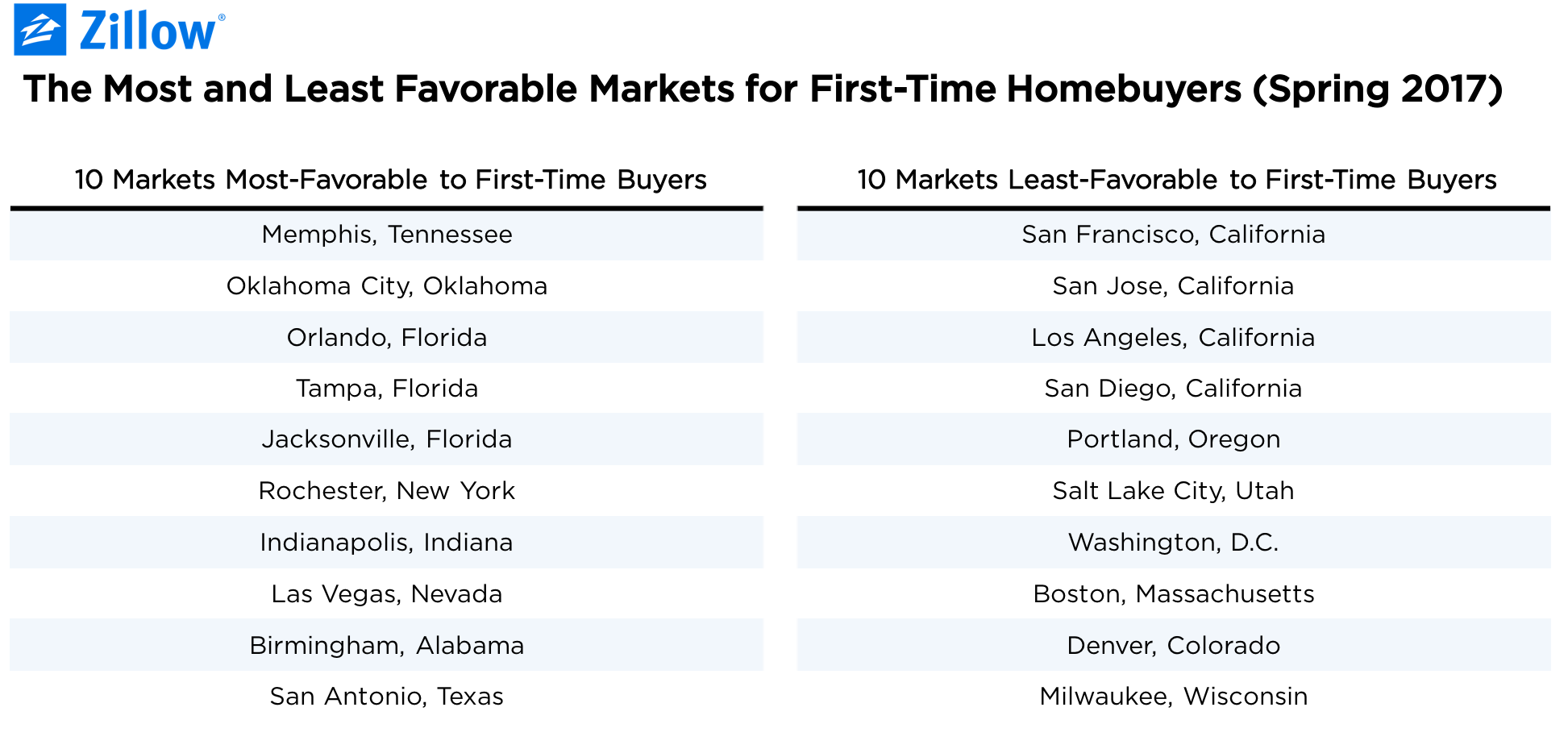
Among the 50 largest U.S. metros included in this analysis, the most- and least-favorable markets for first-time buyers are:
Methodology
The First-Time Home Buyer Index weighs five metrics in a given market:
- Median home values, as measured by the Zillow Home Value Index: Markets with lower home values score higher because of their relative affordability.
- The market’s Zillow Home Value Forecast: Markets with stronger forecasted growth in home values score better, as healthy forecasts indicate a good start for buyers looking to grow equity and wealth.
- The inventory-to-household ratio: Markets with more inventory per household score higher, in an effort to measure available supply for buyers.
- The market’s share of listings with price cuts: Markets with more listings with at least one price cut are assumed to be somewhat less competitive, taking some of the pressure of first-time buyers.
- The local buy-rent Breakeven Horizon:[1] Markets with a shorter Breakeven Horizon demonstrate a stronger financial incentive for local residents to buy instead of rent.
These five metrics are ordered, and metros are scored on each feature on a scale from 0 to 10.[2] These five scores are then averaged, and the average is re-scaled to range from 0 to 10. The higher the score, the better a market is judged to be for first-time home buyers.
Use the interactive tool below to explore conditions for first-time buyers in your local market and markets nationwide.
Related:
- Q4 2016 Breakeven Horizon: Why it May Start Taking Longer to Profit on a Home Purchase in Pricey Markets
- Down Payment the Top Hurdle Holding Back Would-Be Home Buyers
- Without Spending More, Some Renters Could Likely Afford to Buy Above-Average Homes
[1] Zillow’s Breakeven Horizon measures the length of time, in years, in which a buyer would have to live in a home to make it more financially advantageous to buy it than rent it. These timelines are currently influenced by very low mortgage interest rates, among other factors.
[2] Using a uniform distribution.
Sign up for Zillow Research updates
Subscribe to receive weekly emails for the latest Zillow research, weekly housing data, market insights and more.
Related Articles



Research in your inbox
Get the latest housing data and analysis from Zillow's economists — delivered when the numbers update.

