Mortgage Rates Steady, But Tax Reform Could Mean Higher Rates Ahead
Absent spending cuts, the Tax Cuts and Jobs Act – enacted in December – is likely to boost federal government borrowing, meaning that mortgage borrowers will increasingly be competing with Uncle Sam for long-term loans at the same time more investors are willing to take a risk on overseas investments, which could mean less money for U.S. markets, including bonds. Together, these forces should push up interest rates over the coming months.

Written by Aaron Terrazas on January 17, 2018
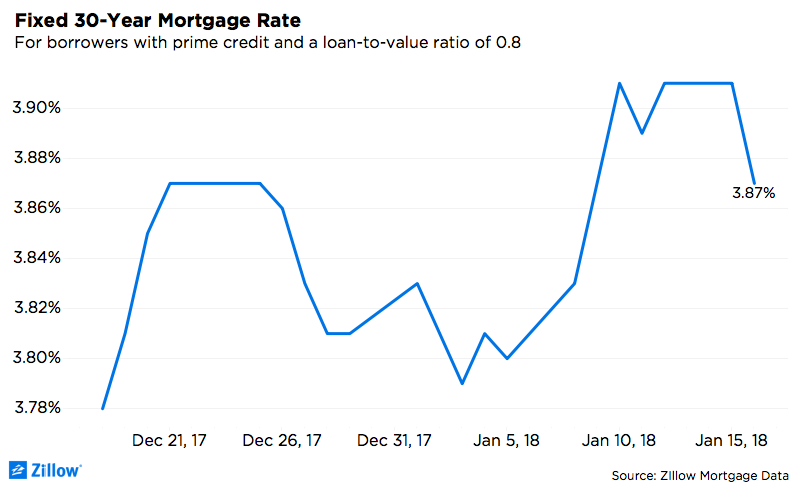
The average prime 30-year fixed mortgage rate quoted on Zillow was flat this week, holding steady after rising sharply the previous week to its highest levels since July.
Financial markets were closed on Monday for the Martin Luther King, Jr., holiday and lenders typically price conservatively going into long holiday weekends. As a result, the average rate quoted on Zillow edged a few basis points higher over the weekend but soon returned to last week’s levels.
Over the past few years, monetary policy expectations and geopolitical news have dominated big moves in interest rates, but markets are increasingly paying attention to the fiscal policy outlook.
The Federal Reserve has repeatedly signaled a steady path ahead for short-term interest rates and geopolitical risk appears to have ebbed – at least for the moment. More importantly, the global economic outlook has perked up – with the economic outlook in Europe and Japan increasingly optimistic.
As a result, the key variable on the horizon is the U.S. fiscal outlook. Absent spending cuts, the Tax Cuts and Jobs Act – enacted in December – is likely to boost federal government borrowing, meaning that mortgage borrowers will increasingly be competing with Uncle Sam for long-term loans at the same time more investors are willing to take a risk on overseas investments, which could mean less money for U.S. markets, including bonds. Together, these forces should push up interest rates over the coming months.
Economic data releases on the calendar for the coming week are unlikely to dramatically shift markets, but there is a near-term risk that Congressional negotiators will fail to agree to a federal budget. If negotiations fail and the federal government shuts down, there could be some volatility in lending markets, although the effects would ultimately be short-lived.
Tags
Sign up for Zillow Research updates
Subscribe to receive weekly emails for the latest Zillow research, weekly housing data, market insights and more.
Related Articles




Research in your inbox
Get the latest housing data and analysis from Zillow's economists — delivered when the numbers update.

